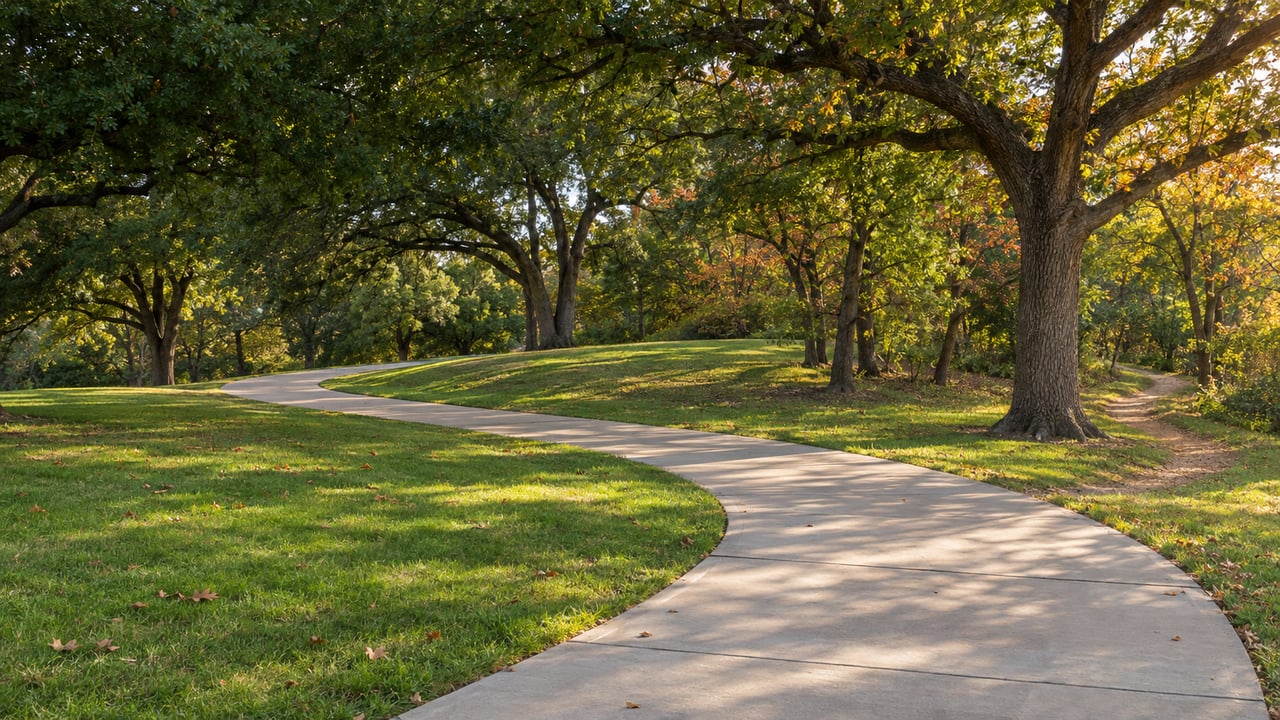
On a Coppell trail, an e-bike is either banned or allowed, and what decides it is the ground under the tires. Where the tread is packed native dirt, Texas law lets a city keep e-bikes off even where regular bikes may ride. Where someone has poured concrete or laid down surfacing, Texas law treats an e-bike almost exactly like a regular bicycle, and the city has very little room to treat the two differently. That one line explains the ordinance Coppell passed in 2025, the complaints the police chief described this fall, and the request the city has now sent toward Austin.
The Rule Coppell Wrote for Dirt
On July 22, 2025, the Coppell City Council added a new subsection to the Parks and Recreation Code. Here is the operative text from the ordinance:
"No person shall ride, use, or operate any bicycle or e-bicycle on the Biodiversity Education Center Trail System in its entirety, or upon any unimproved surface located within Coppell Nature Park, or Wagon Wheel Park."
The rule covers every bicycle, pedal or powered. In his staff memo, Police Chief Danny Barton explained that regular bicycles were already barred from the Biodiversity Education Center nature trails. The 2025 change extended that ban to e-bikes so both would be treated alike and the trails would be protected from damage.
The ban names three places: the full Biodiversity Education Center Trail System, unimproved surfaces in Coppell Nature Park, and unimproved surfaces in Wagon Wheel Park. Outside the Biodiversity Education Center system, the ban reaches only unimproved surfaces, and that wording echoes state law.
The State Law That Drew the Line
Texas starts from one principle. Section 551.002 of the Transportation Code says a provision that applies to a bicycle also applies to an electric bicycle, unless by its nature it can't. Section 551.106 then limits what a city can do. A local authority may not prohibit an e-bike anywhere a regular bicycle is allowed, with one exception. Under the statute, the exception is a path that:
- is not open to motor vehicles, and
- has "a natural surface tread made by clearing and grading the native soil without adding surfacing materials."
The "unimproved surface" language in Coppell's park provisions points at the same kind of ground as the state's carve-out for natural-soil paths. Because the ordinance also bans regular bicycles in those places, it keeps both kinds of bike off the same trails.
The statute does leave cities two other tools. A local authority may ban bicycles from sidewalks and may set bicycle speed limits on paths where bikes can ride. Section 551.002 carries both tools over to e-bikes, but they reach every bicycle, so a sidewalk ban or path speed limit aimed at fast e-bikes would also apply to a child on a regular bike. Coppell's FAQ shows the city currently allows all e-bike classes on its sidewalks.
Where Each Kind of Bike Can Go Today
The city's e-bike FAQ states the paved-side rules directly. All e-bike classes may ride on public roads, sidewalks and bike paths in Coppell. It also separates e-bikes from vehicles that only look like them. A bike without working pedals that runs only on its motor is legally not an e-bike, even if its pegs look like pedals. The FAQ calls these mini motorbikes or pocket bikes and says they aren't allowed on public roads, sidewalks or bike paths in Coppell. They can't be registered in Texas and are for private property only.
| Where | Pedal bicycle | E-bike, any class | Pocket bike or mini motorbike |
|---|---|---|---|
| Biodiversity Education Center Trail System | Not allowed | Not allowed | Not allowed |
| Unimproved surfaces in Coppell Nature Park | Not allowed | Not allowed | Not allowed |
| Unimproved surfaces in Wagon Wheel Park | Not allowed | Not allowed | Not allowed |
| Public roads, sidewalks, bike paths | Allowed | Allowed | Not allowed |
The bottom row covers most of the city's shared space, and it's where the complaints come from.
What the Police Chief Described This Fall
At the City Council's September 8, 2026 work session, recorded in the city's meeting video archive, Barton said e-bike complaints had grown over the previous year or two, especially in summer, and that parks were the main location of concern. He described riders moving fast and conflicts with other trail users, including children and people walking dogs. Parks staff had also reported bicycles cutting across fields and damaging turf.
He also said who was getting ticketed. According to the same recording, police had written tickets mostly to riders aged 10 to 13 on e-bikes going at high speed on trails. Barton separated those riders from pedal-less, motorcycle-style machines, which he said police already enforce under separate rules as mopeds or pocket bikes. He told the council the city had not had accidents in the situations he cited.
The problems he listed happen on the paved trails and in the parks, and state law leaves the city few tools there short of rules that also cover regular bikes.
What Coppell Asked Austin For
Two weeks later, on September 22, the council approved a resolution asking the Texas Municipal League to support state legislation giving cities authority to regulate or prohibit e-bikes on sidewalks, trail systems and other pedestrian facilities. Coppell Student Media reported the vote, noting that it follows the existing restrictions on unimproved trails near the Biodiversity Education Center.
The staff memo behind the resolution lays out the reasoning. Because Texas law classifies e-bikes the same as bicycles, cities are limited in addressing their "unique safety and operational concerns." It names conflicts with pedestrians, "including children, adults, seniors, families, and persons utilizing mobility assistance devices." The memo lists the specific powers the city wants:
- regulating e-bikes separately from traditional bicycles on pedestrian facilities
- distinguishing among the classes of e-bikes
- addressing modified e-bikes and changes that materially alter a vehicle's speed or operating characteristics
- setting reasonable operating requirements
At the September 22 meeting, according to the city's recording, staff explained that this year's version had been revised. The prior year's resolution asked TML to seek and file legislation itself. This one asks TML to support legislation that others sponsor.
The resolution appears in TML's packet of resolutions submitted to its membership under the title "City Authority to Regulate Electric Bicycles," and the packet is dated November 12, 2026, in San Antonio. According to the same document, TML's board finalizes its 2027–2028 legislative program in December. Any change to the paved-side rules would have to come from the Legislature.
The State Rules Every Rider Already Carries
Some rules already apply to every e-bike on a Coppell sidewalk, set by state law and not by the city. Texas defines an e-bike as a bicycle with fully operable pedals, a motor under 750 watts, and a motor-assisted top speed no higher than 28 miles per hour. Classes 1 and 2 cap assisted speed at 20 mph. Class 3 assists above 20 mph but stays below 28. Under Section 551.107, a rider must be at least 15 to operate a Class 3 e-bike, and the motor has to cut out when the rider stops pedaling or applies the brakes. Coppell also has a youth helmet requirement for e-bike riders. The city's e-bike FAQ is the place to check the current age before a teenager heads out.
Flower Mound took a different approach in 2025. Its Ordinance 15-25, adopted May 5, 2025, regulates behavior on public ways and property for bicycles and micromobility devices. It requires helmets for children under 14, lights at night, no handheld electronics or hearing-inhibiting headphones, and yielding and slowing with an audible warning when passing pedestrians. That ordinance governs how people ride, not where, which is the kind of rule state law leaves cities free to write.
This post is general information, not legal advice. Before relying on any rule for your family's riding, read the linked ordinance, statute or city FAQ, or contact the City of Coppell.
At The Hahn Team, we follow how Coppell decides what happens on its trails and sidewalks, because those decisions shape the daily routines of the families we serve. If you'd like to talk about how city decisions like this one play out on your street, we're glad to help you Make Your Best Move.