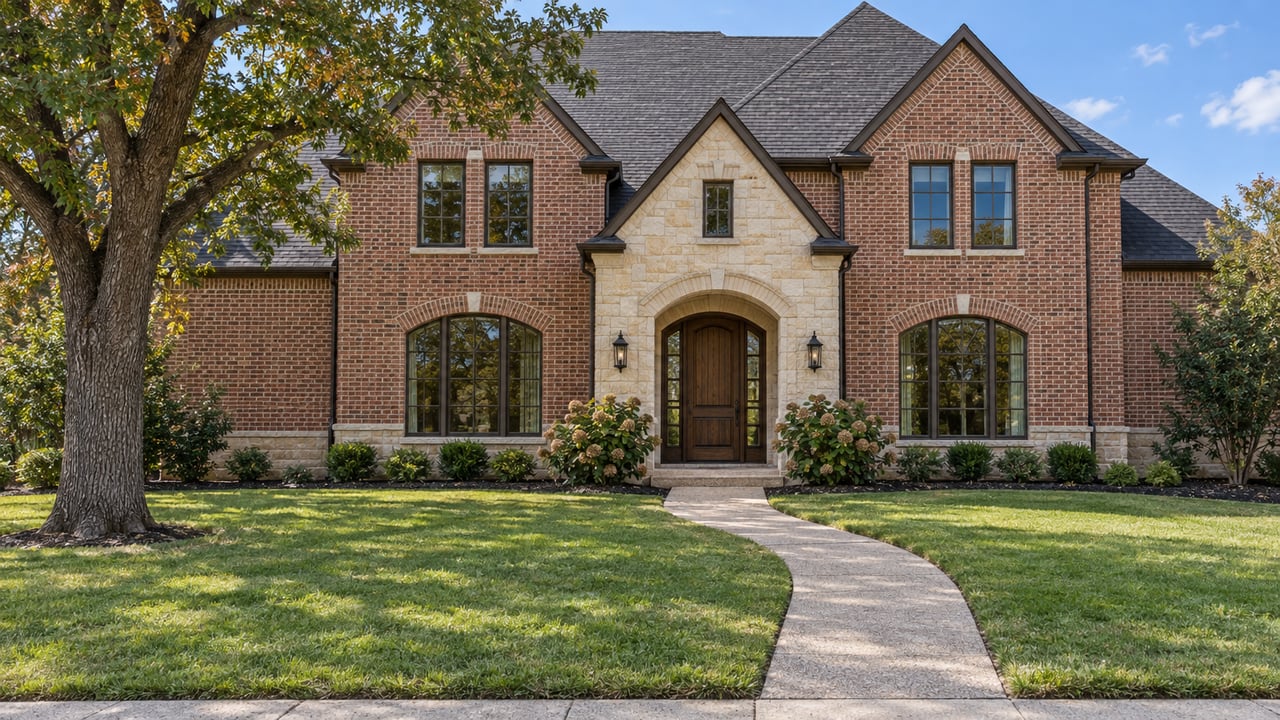
The 1904 Kirkland House at Coppell Heritage Park does not stand where the Kirkland family built it. According to its plaque, it was moved 474 feet due west and restored in 2011. The Minyard Store next to it came 1,720 feet. The windmill came from a farm. The stone columns at Houston Street are replicas, and the train depot is a replica too. Coppell's name came from a sign on a depot. The Coppell Historical Society has put markers on most of these places, and the markers say where each piece started. Read them in order and they show a town that kept moving its past until it was all in one place.
A Name Borrowed From a Depot Sign
Before it was Coppell, Old Town was the Gibbs settlement. It was named for Barnett Gibbs, a political figure who later became lieutenant governor of Texas. He owned a ranch south of the area but never lived there. The first post office opened in 1887, inside the Harrison family's general store.
In 1888 the St. Louis, Arkansas and Texas Railway built a depot known as Gibbs Station. The Historical Society's narrative says a second depot followed in 1890, and it carried the name Coppell. The name honored George A. Coppell, a railroad investor and board member. The post office made the change official in 1892. The Texas State Historical Association's Handbook of Texas also puts the renaming in 1892 but describes it as the depot itself being renamed, so the two accounts differ slightly on the order of events.
The depot marker on South Coppell Road makes a bigger claim. In 1892, it says, the town officially changed its name from Gibbs to Coppell, "thus making it the only Texas town to assume the name of its railroad depot." The same plaque says the large depot was later replaced by a smaller one. In 1957 that small depot was sold and moved west of town, onto land that is now airport property. The large depot that carried the Coppell sign is gone, its successor was moved out of town, and what stands on South Coppell Road today is a replica.
The Corner That Became a Park
Coppell Heritage Park sits at the southeast corner of West Bethel Road and South Coppell Road. Its 2013 marker says the town began here in the late 1870s, when this stretch held general stores, a post office, a bank, a drug store, blacksmiths, schools, churches and homes.
Before it was a park, the corner held several houses, a service station and a temporary movie theater at different times. It became a historical park in 2003, when the Thweatt family donated an antique windmill. The Kirkland House and the Minyard Store came later. The marker credits the Wheelice Wilson family, who lived on the site starting in 1947, with making the park designation possible. A bench near the Ihnfeldt House remembers Wheelice "Pete" Wilson. He was a past president of the Historical Society and helped create Heritage Park.
Nearly every object in the park came from somewhere else:
| Piece | Where it came from | When it arrived or was restored |
|---|---|---|
| Kirkland House, built 1904 | 474 feet due east of its current spot | Restored 2011 |
| Minyard Store | 1,720 feet away, at Minyard Corporate Offices | Restored 2011 |
| Windmill | The Thweatt Farm, given by J.C. Thweatt | 2003 |
| Bethel School steps | The 1890s Bethel School site at S. Moore and E. Bethel School Road | Marker placed 2023 |
The Minyard Store has the most layered history of the four. Its plaque calls it a small grocery store remodeled to look like the first Minyard store in East Dallas, then moved to the Minyard corporate offices in Coppell in 1980. After that the Minyard family donated it to the city, and it was moved again and restored in 2011. That makes it a copy of a Dallas store that has been moved twice, and it now stands in Coppell's history park as a reminder that Minyard had its headquarters here.
The Kirkland House plaque lists the family who lived there: John M. and Edna Jeanette Kirkland and their children Hubert, Lois, Sallie, Jewel, also called Jack, Stringfellow, Louise and Carroll. The 2011 restoration was done by the Jean and Price Daniel Foundation, the Coppell Historical Society and the City of Coppell. One of those children shows up again two blocks away. Sallie Kirkland Brooks taught at the one-room Bethel School, whose steps now sit at the south side of the park.
Even the Barbershop Was Moved
The building at 456 West Bethel Road follows the same pattern. Floyd and Clayta Harwell bought a small house there in 1932. It had been a telephone operator's office, and they added a large room on the west side for Floyd's Barbershop. In 1956 Floyd bought the corner lot next door, where a service station had stood, and moved a small building onto it to use as the barbershop.
Floyd Harwell cut hair in Coppell for more than four decades and umpired the town's baseball team as a volunteer in the 1940s. Clayta Harwell was station manager at the railroad depot and ran the cafeteria at Coppell School in the 1940s and 1950s. The depot marker on South Coppell Road also names Clayta Plumlee Harwell, along with Oscar Cooper, as longtime railroad agents. That connects the barbershop on Bethel to the depot replica a few blocks south.
The Buildings That Stayed Put
At 616 South Coppell Road, J.T. Maynard built Coppell's first fire station in 1958. A siren beside it went off whenever someone called the department's phone number, and whoever was nearby ran to answer while the volunteer firefighters gathered. Maynard built the first city hall next door in late 1959. It started as one large meeting room and was later expanded by volunteers to include two jail cells. In 1972 a third building went up behind the first two to hold the permit office and the office of George Campbell, the city's first city manager. Amcat Adjusting Services bought and renovated the property in 2012.
The water tank on Bethel Road dates to the late 1960s. The well under it is much older. It was tapped about 1911 to feed a wooden overhead tank and a public watering trough for horses. In the 1940s a washeteria just behind the marker's spot let residents do laundry in wringer washing machines. The Exchange Club painted the city logo on the tank as Coppell got ready for its centennial.
The Columns at Houston Street
The stone columns at the corner of South Coppell Road and Houston Street started out at Grapevine Springs Park. In 1937 the Works Progress Administration marked the park's two entrances with stone columns, one set at the end of Park Road and one on South Coppell Road. The west entrance closed during World War II, and those columns were eventually taken down to make way for development. In 2014 the City of Coppell built the replicas that stand there now, using some of the original stones.
Like the depot and the Minyard Store, the columns are a rebuild. The original stones help make them more than decoration.
Where the Walk Ends: Grapevine Springs
Grapevine Springs Park is the one stop on this route whose history doesn't depend on a building being moved. Its marker says the springs have drawn visitors for more than 2,000 years. Sam Houston, then president of the Republic of Texas, camped here in 1843 during treaty negotiations with Native American tribes, and the treaty was later signed at Bird's Fort. Dallas County accepted the land as a park in 1936, and the WPA built rock walls, picnic areas and footbridges. A separate plaque stands at the foot of the Houston Campsite Oak, one of the trees Houston's party is said to have camped under.
The park's ownership changed hands several times. The Historical Society's narrative says the land went back to its original owners after World War II, was later bought by A. Webb Roberts, and passed to the Baptist Foundation. In 1991 the foundation gave 15 acres to Dallas County. The city then agreed to lease the land for 99 years and maintain it. The city's facility page now lists the park at 23 acres, with nature trails, a pond and stream, and picnic areas. The marker describes work to restore the WPA features as ongoing.
The Route, in Order
The Coppell Historical Society lists these locations for its markers.
- Coppell Heritage Park, SE corner of W. Bethel Road and S. Coppell Road. Stops: the Heritage Park marker, the Kirkland House at 700 S. Coppell Road, the Minyard Store, the Thweatt windmill, the Bethel School steps and the Wilson bench.
- Harwell House and Barbershop, 456 W. Bethel Road.
- Water tank marker, Bethel Road.
- First fire station and city hall, 616 S. Coppell Road.
- Depot marker, S. Coppell Road in front of the Life Safety Park depot replica.
- Replica WPA columns, S. Coppell Road at Houston Street.
- Grapevine Springs Park, north entrance off Park Road. Find the park marker and the Houston Campsite Oak.
Life Safety Park is run by the Coppell Fire Department. It's staffed Monday through Friday, 7 a.m. to 4 p.m., and visits are by appointment except during public events. Its playground is open sunrise to sunset. The City's Life Safety Park FAQ has the details. If you'd rather explore from home first, the Coppell Historical Society links to an Interactive History Map from its homepage.
Two other markers are a short drive off the route. The Native American Sites marker, put up in 2019, sits beside the concrete walk in Andy Brown Central Park on the east side of Denton Tap Road. It records campsites in the Denton Creek area going back as far as 3,000 BCE. The Parrish Family Cemetery at 746 Cardinal Lane holds more than 35 members of the family who received a 640-acre Peters Colony grant and settled here in 1853.
Saturday, December 5 is a good day to walk the route. The Boho Market holds its Vintage Christmas Market at Old Town Coppell, 489 W. Bethel Road, from 9 a.m. to noon. That evening, the City of Coppell calendar lists the Holiday Parade & Tree Lighting at Andrew Brown Park East from 6 to 9 p.m. Check both listings closer to the date, since schedules can change.
The town is still collecting its own history. In June 2026, Cozby Library and Community Commons recorded residents telling their stories at a no-registration event called Coppell Oral Histories: Live!, saving them for future generations.
At The Hahn Team, we enjoy knowing where things in Coppell came from, from the 474 feet the Kirkland House traveled to the depot sign that named the town. If you have a question about an Old Town street or a story you'd like us to look into, reach out. Make Your Best Move.